
Crypto Trading Signals: Complete Guide for 2026

The crypto market in 2026 presents a challenging landscape. Bitcoin continues hovering between $70k and $75k with sharp intraday swings, while altcoins rotate rapidly as traders chase momentum across sectors. In this environment, many investors are turning to crypto trading signals as a way to navigate market volatility without spending every waking hour analyzing charts.
A trading signal is a time-stamped instruction that tells you when to buy or sell a specific cryptocurrency. Each signal typically includes an entry price, stop-loss level, take-profit targets, and a suggested time horizon. These signals come from experienced human analysts, algorithmic systems, or AI models trained on historical price and on-chain data.
This article is written from SaintQuant’s perspective as an AI crypto quant trading bot platform. We focus on realistic, risk-aware use of signals—not get-rich-quick promises. Signals are tools to improve decision-making and potentially enhance risk-adjusted returns, not guaranteed profit machines.
Signals ≠ certainty. Signals = probabilities.
Understanding this distinction separates successful traders from those who blow up their portfolios chasing false signals.
How Crypto Trading Signals Work (Answering the Basics Fast)
The core pipeline behind any trading signal follows a straightforward path:
-
Data in: Price feeds, trading volume, order book data, funding rates, and on-chain metrics flow into the system
-
Model/analyst processing: Human analysts or algorithms analyze this data using technical analysis, quantitative rules, or machine learning
-
Signal out: The system generates a specific trade recommendation with defined parameters
-
Trade execution: You receive the signal and either manually execute or let a bot handle it automatically
A typical signal contains these elements:
-
Asset pair (e.g., BTC/USDT, ETH/USDT)
-
Direction (long or short)
-
Entry price range
-
Stop-loss level
-
Take-profit targets (often tiered)
-
Time horizon
-
Risk note or confidence level
Delivery methods vary widely. Some traders prefer Telegram or Discord channels for real-time alerts. Others use email notifications or in-app push alerts. For fully automated execution, platforms connect directly via exchange APIs to place orders without manual intervention.
Here’s a concrete example from a fictional 2026 scenario:
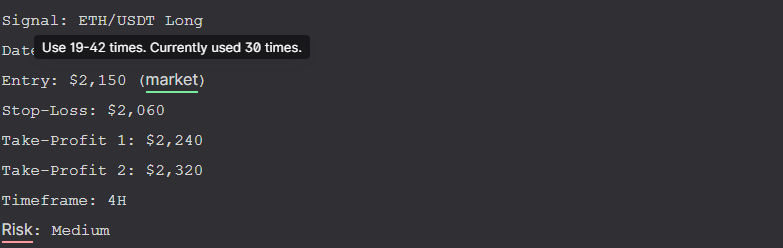
This signal specifies exact levels, allowing traders to calculate position size based on their risk tolerance before entering.
Types of Crypto Trading Signals
Different signal types reflect different underlying strategies and time horizons. Understanding these categories helps you choose signals aligned with your trading style.
-
Technical-analysis signals: Generated from candlestick patterns, support and resistance levels, moving averages, RSI, MACD, and other technical indicators. A dragonfly doji or gravestone doji pattern might trigger reversal signals, while a long legged doji indicates market indecision during a trading session.
-
Quantitative/algorithmic signals: Rule-based systems using statistical filters, volatility adjustments, and trend-following logic. These operate without emotional bias and can process data across many assets simultaneously.
-
AI/ML-based signals: Pattern recognition models trained on historical price data, on-chain metrics, and market sentiment indicators. They detect regime shifts and anomalies that traditional indicators miss.
-
On-chain and sentiment signals: Track wallet flows, funding rates, and the Fear and Greed Index. Strong buying pressure or strong selling pressure from whale wallets often precedes significant moves.
-
Arbitrage and spread trading signals: Identify price discrepancies between exchanges or correlated pairs. Lower risk but typically smaller returns.
-
Copy-trading/social signals: Follow specific traders’ positions rather than formulas. High variance depending on the trader being copied.
SaintQuant focuses on quant signals, AI-driven pattern recognition, trend following, and arbitrage strategies. We deliberately avoid purely hype-based or influencer-driven calls that often produce false signals.
Signal Generation: From Indicators to AI Quant Models
Professional signals aren’t random guesses. They’re outputs of structured models and backtested rules refined across market cycles.
Classic indicator-based generation combines multiple technical tools:
-
Moving average crossovers (e.g., 50-day crossing above 200-day)
-
RSI readings below 30 (potential bullish reversal) or above 70 (overbought)
-
MACD divergences signaling possible shift in market momentum
-
Volume spikes confirming breakouts beyond key support level or resistance zones
-
Upper shadow and lower shadow analysis on candlestick patterns
Quantitative approaches used by platforms like SaintQuant include:
-
Trend-following rules that capture sustained directional moves
-
Volatility filters that reduce exposure during choppy sideways markets
-
Risk-parity position sizing so each trade risks similar capital
-
Regime classification distinguishing trending markets from ranging conditions
Machine learning applications take signal generation further:
-
Feature engineering from price, higher volume data, funding rates, and on-chain activity
-
Models like gradient boosting or LSTMs predict return distributions rather than single price targets
-
Walk-forward testing validates models on data they’ve never seen, reducing overfitting
-
Focus on probability outputs rather than magical predictions
Well-built AI signals emphasize risk distribution and embed safeguards. The intrinsic value of these models lies in their systematic approach—they don’t panic during drawdowns or get greedy during a strong uptrend.

How to Use Crypto Trading Signals in Your Strategy
Signals must fit within your overall trading plan. Your capital allocation, time commitment, and risk tolerance should guide how you implement them.
Discretionary use treats signals as ideas to validate:
-
Run your own technical analysis on the same level before executing
-
Filter signals by market conditions—avoid aggressive mean-reversion during a clear trend
-
Check if the next candle confirms the signal’s premise before entering
Semi-automated use balances control with efficiency:
-
Bots place orders automatically based on signals
-
You maintain manual control over risk parameters
-
Switch strategies on or off based on changing conditions
Fully automated use requires high trust in your provider:
-
Connect your exchange via API to platforms like SaintQuant
-
Predefined strategies execute signals automatically within agreed risk limits
-
Monitor performance metrics without managing individual trades
Timeframe considerations matter:
-
Intraday scalping signals (5m–15m charts) require constant monitoring, hold for short periods
-
Swing-trade signals (4H–1D charts) offer more flexibility, hold for days
-
Position signals on weekly charts suit investors with longer horizons
Warning: Subscribing to multiple conflicting signal services simultaneously creates confusion and often leads to overtrading. Focus on one or two aligned providers.
Risk Management When Following Crypto Signals
Even the best signals lose money frequently. Your risk management determines whether you survive drawdowns and achieve long-term returns.
Position sizing basics:
-
Risk a fixed fraction of capital per trade (0.5–2% for most traders)
-
Never go all-in on any single signal regardless of confidence
-
Leverage multiplies both gains and losses—higher risk means faster ruin during losing streaks
Stop-loss and take-profit discipline:
-
Blindly moving stops wider usually compounds losses rather than saving trades
-
Accept planned losses rather than hoping for reversals
-
Asymmetric R:R ratios (risking 1% to gain 2–3%) allow profitability even with lower win rates
Diversification across multiple dimensions:
-
Trade different assets (BTC, ETH, SOL, altcoins) to avoid concentration
-
Use multiple timeframes (intraday, swing, position) for different holding periods
-
Combine strategy types (trend following, arbitrage, mean reversion) to smooth equity curves
SaintQuant’s integrated risk controls:
-
Predefined max drawdown per plan prevents catastrophic losses
-
Dynamic exposure reduction during high volatility periods
-
Automatic position scaling based on detected market regime
-
Transparent risk parameters visible in your dashboard
Evaluating the Quality of a Crypto Signal Service
Due diligence is critical. The 2020–2025 period saw countless failed signal groups, rug pulls, and services that showed red flags from the start.
Objective metrics to demand:
-
Verified historical performance with time-stamped trades
-
Returns calculated net of gas fees and realistic slippage
-
Maximum drawdown figures across different market conditions
-
Consistency through the 2022 crypto winter, 2024 halving year, and 2025–2026 cycles
Transparency indicators to look for:
-
Public strategy descriptions (without revealing proprietary code)
-
Clear risk assumptions and example trades
-
Explicit disclaimers that past performance doesn’t guarantee future results
-
Contact information and identifiable team members
Red flags that signal trouble:
-
Promises of fixed daily ROI or “guaranteed profits”
-
Claims of “no-loss bots” or 100% win rates
-
Anonymous operators with no verifiable track record
-
Pay-to-enter Telegram groups offering zero data before payment
SaintQuant offers tiered subscription plans with stated target ROI ranges, duration options, and explicit risk profiles. Every plan includes performance dashboards and acknowledges that returns vary based on market conditions.
AI Trading Bots vs Manual Signal Groups
The choice between human analysts posting signals in Discord and AI bots executing automatically involves real tradeoffs.
Pros of manual signal groups:
-
Contextual commentary explaining the reasoning behind each trade
-
Flexibility when unexpected events (regulatory announcements, exchange issues) hit
-
Educational value for traders learning price action and chart reading
-
Macro narratives that help investors understand broader market direction
Cons of manual groups:
-
Emotional bias affects recommendations, especially after consecutive losses
-
Inconsistent posting times based on analyst availability
-
Limited coverage—humans can only watch so many pairs
-
Selling pressure from group dynamics can push poor decisions
Pros of AI/quant bots like SaintQuant:
-
24/7 monitoring across dozens of pairs and multiple exchanges
-
Strict rule-following without fear or greed influencing decisions
-
Instant reaction to signals when they occur frequently
-
Complex multi-factor signals (trend, volatility, funding rates, on-chain data) unified in one system
Cons/limitations of bots:
-
Dependence on historical data quality and model assumptions
-
Potential underperformance during black-swan events not in training data
-
Requires ongoing maintenance and recalibration as market regimes shift
-
Cannot contextualize truly novel situations the way humans can
Most people find a hybrid approach works best—automated execution with human oversight for major strategy changes.
Common Pitfalls When Using Crypto Trading Signals
Many traders lose money despite receiving quality signals. Behavior, not signal quality, often determines outcomes.
Behavioral pitfalls:
-
Overtrading by taking every signal across all pairs without capital limits
-
Doubling position size after losses trying to recover quickly
-
Canceling stop-loss orders when trades move against you
-
Chasing momentum after buyers regained control, entering too late
Cognitive mistakes:
-
Cherry-picking winning examples from a provider’s marketing while ignoring losses
-
Survivorship bias—following strategies that look great in past data but weren’t live during those periods
-
Assuming what worked in sideways markets will work during strong trends
FOMO and social pressure:
-
Joining “VIP” groups based on screenshots of huge wins
-
Raising risk near cycle tops like late 2021 or speculative alt runs
-
Copying positions from influencers who show gains but hide their stocks of losses
The Terra/LUNA collapse in May 2022 devastated traders who ignored risk management. Many signal providers had recommended Luna accumulation. Those without proper position sizing and stop-losses lost access to their entire capital. Those using proper risk controls limited losses to manageable percentages.
SaintQuant’s Approach to Crypto Trading Signals and ROI Plans
SaintQuant is an AI-powered crypto quant trading bot platform focused on diversified, risk-managed strategies for individual investors who understand that investing always involves uncertainty.
Key strategy pillars:
-
Trend following on major pairs (BTC, ETH, SOL) across higher timeframes to capture directional moves
-
Market-neutral and arbitrage signals exploiting exchange spreads and funding rate mispricing
-
Machine learning models for signal modeling and regime detection
-
Dynamic allocation that shifts between strategies based on detected conditions
Subscription plan structure:
-
Plans differentiated by risk level (conservative, moderate, aggressive)
-
Target ROI ranges stated as ranges, not guarantees
-
Duration options (30-day, 90-day, 180-day strategies)
-
Explicit max drawdown parameters for each plan
User experience:
-
Web-based dashboard for setup and monitoring
-
Connect your exchange via secure API (your money stays on your exchange)
-
Choose plan, allocate capital, monitor live performance
-
Access underlying signal logs showing timestamps, direction, and position sizes
-
Resources for understanding each strategy’s logic
The difference between SaintQuant and unrealistic competitors lies in transparency. We show both winning and losing trades, publish drawdown figures, and never promise companies of fixed returns.
Getting Started With Crypto Trading Signals in 2026
For readers new to signal services, here’s a concise path forward:
-
Step 1: Define your goals and risk tolerance. How much of your portfolio are you willing to allocate? What’s your time horizon—6 months, 2 years, longer?
-
Step 2: Choose your engagement model. Manual signals for learning, automated bots for efficiency, or a hybrid approach combining both.
-
Step 3: Review verified performance before allocating significant capital. Check historical returns across bull and bear periods, not just cherry-picked wins.
-
Step 4: Start small. Allocate a fraction of intended capital for 1–3 months. Experience drawdowns firsthand before scaling.
-
Step 5: Scale gradually if results match expectations. Low volume initial positions let you learn without catastrophic losses.
Maintain a simple trading journal noting which signals you followed, your reasoning, and how you felt during drawdowns. This data helps you understand your actual risk tolerance versus your theoretical one.
SaintQuant offers plans suitable for cautious first-time users as well as higher-risk strategies for experienced traders comfortable with larger drawdowns. Explore our options to find one matching your seed phrase of caution or aggression.
Conclusion
-
Crypto trading signals are structured, probabilistic trade ideas that help disciplined traders navigate complex markets—but they’re not guarantees of profit
-
Quality of signals, strict risk management, and your own behavioral discipline jointly determine long-term portfolio outcomes
-
AI and quant platforms like SaintQuant automate complex signal generation and execution while embedding risk controls that many traders struggle to maintain manually
-
Start small, evaluate performance honestly across different market conditions, and choose tools aligned with your risk profile and time commitments
Looking ahead beyond 2026, AI-driven signals will likely incorporate deeper on-chain integration, cross-asset correlation models, and improved regime detection using blockchain technology advances. The trend toward systematic, disciplined trading over emotional decision-making will continue accelerating. Whether you’re tracking junk bonds correlations, monitoring smart contracts activity, or analyzing traditional stock market data alongside crypto, the principles remain constant: probability-based thinking, embedded risk controls, and honest performance evaluation.
Your journey with crypto trading signals begins with a single, properly-sized trade. Make it count.