
What AI Trading Bots Actually Do in the Cryptocurrency Market and How They Transform Crypto Trading Strategies

AI trading bots are software programs that monitor financial markets around the clock, decide when to buy or sell based on predefined rules or machine learning models, and execute trades automatically through exchange APIs. An ai bot is especially useful for beginners, as it is designed to execute trading strategies based on real-time and historical analysis, automating risk management and market analysis. In the context of crypto trading on platforms like Binance, Coinbase, or Bybit in 2024-2026, these bots place orders in milliseconds—far faster than any human trader could manually click buttons.
Let’s be clear upfront: this is about real, production-grade trading bots, not “magic money machines” that promise guaranteed returns. AI trading bots execute strategies, manage risk, and remove some emotional biases from the trading process. Artificial intelligence is used in financial trading platforms to generate signals, analyze markets, and automate trading decisions across various financial markets, including the stock market, forex, commodities, and cryptocurrencies. They cannot predict the future, guarantee profits, or protect you from market crashes like the 2022 crypto winter.
When you see an ai trading bot placing a limit order for 0.1 BTC at $60,000 on Binance with a stop-loss at $59,400 and take-profit at $62,000, that’s the real work happening—automated strategies running on real time market data, making informed trading decisions without hesitation or fatigue. AI trading bots can also be applied to stock trading, where they analyze stock data, generate trading signals, and help traders make decisions in the stock market.
At SaintQuant, our AI crypto bots perform these same core jobs but specialize in quant trading strategies like trend following and arbitrage, wrapped in subscription plans that don’t require you to code or configure APIs manually.
What AI trading bots actually do:
-
Monitor dozens of coins across multiple exchanges 24/7
-
Generate trading signals based on technical indicators, historical data, or machine learning algorithms—advanced bots use machine learning to detect complex patterns and non-linear relationships in the market
-
Utilize Natural Language Processing to analyze news articles, earnings transcripts, and social media to gauge market sentiment
-
Execute trades automatically when conditions are met
-
Enforce risk limits like stop-losses, position sizing based on volatility, trailing stops, and daily loss caps
-
Rebalance portfolios according to strategy rules—AI trading bots maintain portfolio rebalancing to ensure desired asset allocation amidst changing market conditions
-
Help surface trade ideas by scanning real-time market data and generating actionable opportunities for traders
What they don’t do:
-
Guarantee profits in any market conditions
-
Predict black swan events like exchange collapses
-
Replace the need for user oversight and sound judgment
-
Perform well in every market regime without adjustment
-
Handle unpredictable events like economic crises or political unrest, which can drastically alter market conditions and lead to financial losses
-
Most bots are not designed to handle sudden and extreme market changes, which can potentially result in suboptimal decisions during volatile periods
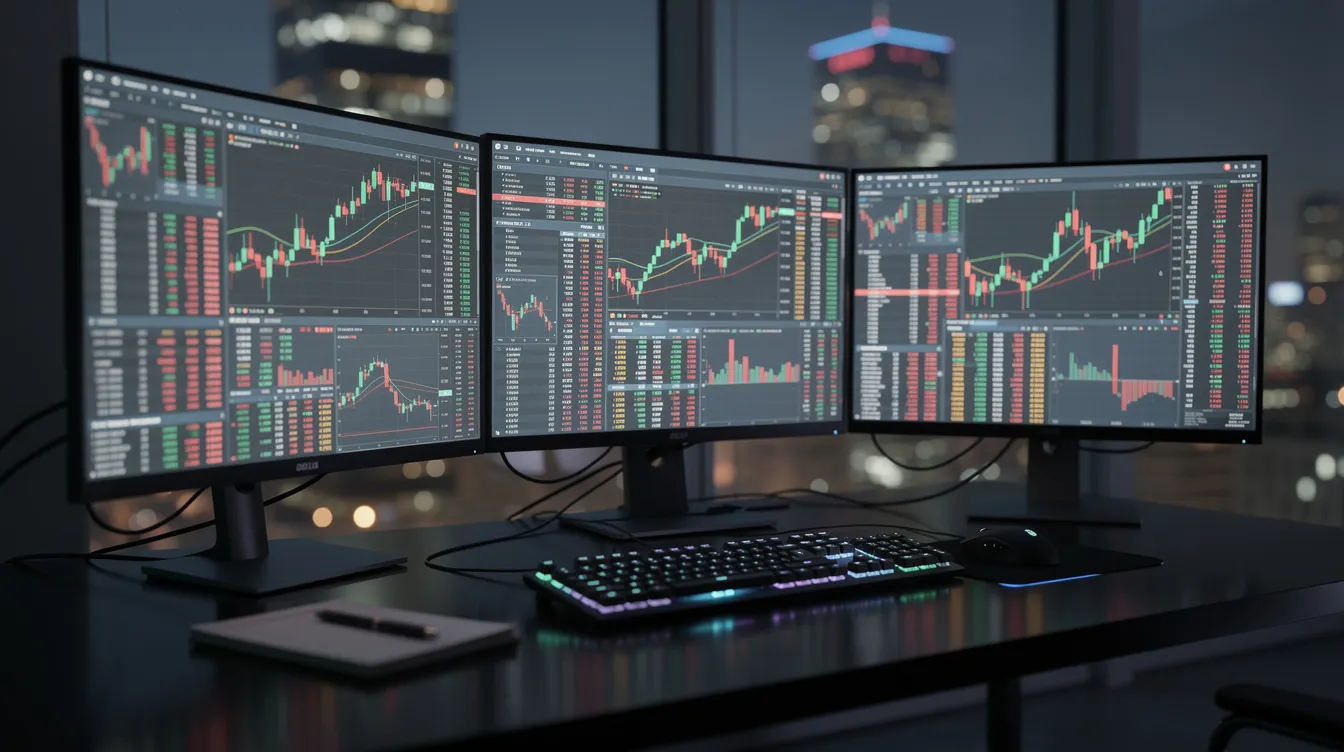
How AI Trading Bots Actually Work, Step by Step
Understanding how automated trading bots function requires walking through their lifecycle: configure → analyze → decide → execute → monitor → learn. This isn’t mysterious—it’s systematic software engineering applied to financial markets.
Let’s trace what happens when a bot analyzes BTC/USDT on Binance at 14:32:15 UTC on a typical trading day.
Connection and data ingestion:
The bot connects to Binance via API keys configured with trading permissions only—no withdrawal rights, which is critical for security. It subscribes to WebSocket feeds delivering real time data: bid/ask prices, order book depth, and volume updates with sub-50ms latency.
Simultaneously, the bot has already ingested historical market data—say, 1-minute BTC/USDT candles from 2020-2025—to backtest strategies and identify patterns. Backtesting is a common feature offered by many AI trading platforms, allowing users to evaluate the effectiveness of their trading strategies using historical data. This historical data forms the foundation for understanding what market behavior has looked like across bull runs, bear markets, and sideways consolidation.
Signal generation and decision logic:
The bot’s brain can be simple hard-coded rules (if RSI drops below 30, buy), quantitative models blending multiple indicators, or full machine learning using gradient boosting or neural networks trained on years of performance data.
At 14:32:15 UTC, the bot detects a signal: price breaks above the 200-day moving average with positive momentum confirmation. The ai models calculate position size—perhaps 1% of a $10,000 portfolio at 5x leverage, risking $100 maximum.
Order execution flow:
-
Signal generated: RSI cross + breakout above key resistance
-
Position sizing calculated: 0.015 BTC at $65,200
-
Limit buy order dispatched via API
-
Fill confirmation received at 14:32:17 UTC (minor slippage)
-
Trailing stop-loss set 2% below entry
-
Take-profit target placed at +5%
The entire process from signal to fill takes under two seconds. The bot then monitors the position, handles any partial fills, and logs every metric for refining strategies later.
SaintQuant wraps this full workflow into an accessible trading platform where users choose a plan and risk level rather than coding rules or wiring APIs manually. Some platforms offer an all-in-one platform that integrates multiple trading tools, smart order functionalities, and analytics into a single interface for cryptocurrency trading. Popular platforms for automated trading include tools like Cryptohopper and 3Commas, which support a wide range of crypto trading strategies.
What AI Crypto Trading Bots Do All Day (Core Jobs)
If you’re already familiar with basic trading concepts, think of AI crypto bots as tireless analysts who never sleep, never panic, and never get distracted. Here’s what they actually do across a typical 24-hour cycle.
Market monitoring
Automated trading bots continuously scan dozens of coins—BTC, ETH, SOL, XRP, and beyond—across crypto exchanges like Binance, OKX, Coinbase, and Bybit. They track price movements, volume spikes, and market volatility in real time. Most traders cannot effectively watch more than a few pairs manually; bots watch hundreds simultaneously across all your exchanges without fatigue.
Strategy execution
When conditions match the strategy’s rules, bots trade automatically. A trend-following bot might enter long when ETH breaks resistance. A mean reversion bot might buy SOL after a sharp dip. Arbitrage bots exploit price differences between various trading platforms. The bot executes without hesitation—no second-guessing, no emotional biases clouding judgment.
Risk management
Powerful bots enforce risk rules ruthlessly:
-
Maximum position sizes per trade
-
Daily loss limits that halt trading if breached
-
Stop-loss and take-profit orders on every position
-
Volatility-based sizing that reduces exposure in fast paced environments
Portfolio management
Beyond individual trades, bots manage portfolio balance. A strategy might maintain 60% in majors (BTC, ETH) and 40% in altcoins, rebalancing daily or weekly based on market conditions.
Order management
Real-world execution involves handling partial fills, slippage in illiquid markets, cancel/replace logic, and market orders when speed matters more than price precision.
Concrete scenarios:
During a BTC flash dip in March 2025 on Bybit, a mean reversion bot detects price dropping to $58,000—well below the 20-day average. It triggers a buy, captures the bounce to $60,500 within hours, and exits profitably while human traders were asleep or frozen by fear.
In January 2026, when ETH breaks $4,000 resistance on Coinbase with surging volume at 09:15 UTC, a breakout bot enters long with 3% portfolio allocation at 10x leverage, trails stops as price climbs to $4,200 by 11:00, and exits at +8% profit.
SaintQuant’s bots perform these same daily jobs but come pre-optimized as quant strategies—not DIY rule builders requiring constant tinkering.

Types of AI Trading Strategies Bots Run (With Crypto Examples)
SaintQuant offers curated, subscription-based AI quant strategies covering several of these families. Instead of forcing crypto traders to design and backtest strategies from scratch, users select a plan matching their risk tolerance and let the AI handle signal modeling and execution.
Many platforms provide access to more bots and advanced features through higher-tier subscription plans or premium upgrades. This allows users to unlock additional bots, backtesting capabilities, and advanced analytics to enhance their trading strategies. For example, StockHero has three subscription tiers: $29.99 for the 'Lite' plan, $49.99 for the 'Premium' plan, and $99.99 for the 'Professional' plan. StockHero also lets users create and test basic trading bots for free, but advanced features require a paid subscription. TrendSpider’s 'Standard' plan costs $107 per month, the 'Enhanced' plan is $197 per month, and the 'Advanced' plan is $447 per month. Bitsgap offers a 7-day free trial on the PRO plan, after which users can upgrade for advanced features. Trade Ideas provides a free 'Par Plan' with delayed market data and basic tools, while its premium tier costs $127 per month or $89 with an annual subscription.
Managing Exchange Accounts: Linking Your Crypto Exchange to AI Trading Bots
Connecting your exchange accounts is the first step to unlocking the full potential of AI trading bots in crypto trading. Most reputable platforms make this process straightforward: you generate an API key from your chosen exchange (like Binance, Coinbase, or Bybit) and input it into the AI trading bot’s dashboard. This secure connection allows the bot to execute trades, manage your portfolio, and implement trading strategies automatically—without ever needing your login credentials.
A key security best practice is to ensure your API key has trading permissions only, with withdrawals strictly disabled. This means the bot can execute trades on your behalf but cannot move your funds out of the exchange, significantly reducing risk. Platforms such as 3Commas and Bitsgap have streamlined this process, letting you manage multiple exchange accounts from a single interface. This centralized approach is especially valuable for crypto traders who operate across various trading platforms, as it enables you to monitor and execute trades on multiple exchanges without juggling separate logins or dashboards.
By linking all your exchange accounts to one AI trading bot platform, you gain a unified view of your holdings and can deploy automated trading strategies across multiple exchanges simultaneously. This not only saves time but also allows for more sophisticated portfolio management and arbitrage opportunities, helping you make the most of your crypto trading activities.
Security and Transparency: Keeping Your Crypto and Data Safe with AI Bots
When it comes to AI trading bots, security and transparency are non-negotiable. Trustworthy platforms go to great lengths to protect your crypto assets and personal data. This starts with robust encryption protocols and secure API connections, ensuring that all communication between your exchange accounts and the trading bot is shielded from unauthorized access.
A hallmark of reputable AI trading bot platforms is their refusal to accept API keys with withdrawal permissions. This simple but critical measure means that, even if a security breach were to occur, your funds cannot be withdrawn by anyone but you. Platforms like Bitsgap have set industry standards by maintaining a spotless security record and prioritizing user safety at every step.
Transparency is equally important. Leading platforms such as 3Commas give users full visibility and control over their exchange accounts—your funds remain on your exchange, and the platform cannot access or move them. Regular security audits, compliance with regulatory standards, and clear communication about how your data is used further build trust.
By choosing an AI trading bot platform that emphasizes both security and transparency, you can focus on refining your trading strategies and growing your portfolio, confident that your assets and information are well protected.
Regulatory Challenges: Navigating Compliance in AI Crypto Trading
The world of AI crypto trading is rapidly evolving, and so are the regulations that govern it. As trading bots and AI trading platforms become more sophisticated, regulatory bodies are paying closer attention to how these technologies are used in financial markets. In the United States, for example, algorithmic and AI trading systems must comply with FINRA and SEC regulations, which require thorough testing, ongoing monitoring, and strict adherence to anti-manipulation rules.
For platforms, this means ensuring that their AI trading bots do not engage in practices that could be seen as market manipulation or unfair exploitation of information. Regular audits, transparent reporting, and compliance with local and international laws are essential to maintaining trust and avoiding legal pitfalls.
Crypto traders also have a responsibility to stay informed about the legal landscape in their jurisdiction. Using AI trading bots in ways that violate local regulations can lead to account restrictions or even legal consequences. The best approach is to choose a platform that prioritizes compliance, keeps users updated on regulatory changes, and provides clear guidance on how to use trading bots within the bounds of the law.
By staying proactive and informed, both platforms and users can navigate the regulatory challenges of AI crypto trading and continue to benefit from automated trading innovations.
Need for Monitoring: Why You Can’t Set and Forget AI Trading Bots
While AI trading bots offer the promise of automated trading and round-the-clock market coverage, they are not a “set and forget” solution. The financial markets are dynamic, with conditions that can shift rapidly due to news events, regulatory changes, or sudden volatility. Even the most advanced AI trading bot, powered by sophisticated machine learning algorithms, requires regular oversight to ensure it continues to align with your trading goals and risk tolerance.
Monitoring your bot’s performance is essential for several reasons. First, it allows you to adjust trading strategies or risk parameters in response to changing market conditions. Second, reviewing performance data helps you identify if the bot is underperforming or behaving unexpectedly—especially important for bots that adapt using machine learning, as they can sometimes develop unforeseen trading behaviors. Third, active oversight enables you to intervene manually if necessary, protecting your portfolio from potential losses during periods of extreme market stress.
Ultimately, while automated trading can reduce the burden of constant manual monitoring, it does not eliminate the need for human judgment. By staying engaged and regularly reviewing your AI trading bot’s activity, you can make more informed trading decisions, refine your strategies, and better manage the inherent risks of trading in fast-paced financial markets.
SaintQuant’s Perspective: What Our AI Crypto Bots Actually Do Differently
Most bot trading tools on the market—platforms like 3Commas, Bitsgap, or Pionex—provide infrastructure for users to build custom strategies or run basic preset automations. SaintQuant takes a different approach specifically for crypto trading.
Key differentiators:
-
Pre-built quant strategies: Rather than configuring rules from zero, users subscribe to strategies with defined ROI targets, duration (30/90/180 days), and risk levels. This removes the guesswork and technical burden from most traders who want to start trading without becoming quant developers.
-
Diversified portfolios: Bots allocate across majors (BTC, ETH) and curated altcoins to reduce single-coin risk. No betting everything on one volatile altcoin.
-
Machine learning signal modeling: ML models trained on multi-year crypto datasets (2018-2025) refine entry and exit timing, adapting to regime changes like the shift from 2021 bull market to 2022 bear market conditions.
-
Dynamic exposure management: Bots scale position sizes up or down based on volatility metrics, Sharpe ratio thresholds, and drawdown levels—not static allocations that ignore changing market conditions.
-
Built-in risk controls: Hard caps on leverage (no 100x gambling), per-strategy risk budgets, and automatic de-risking during extreme drawdowns or systemic events like exchange collapses.
Example plan in action:
Consider a “Moderate Risk Trend Plan” with 90-day duration, 15-25% ROI target, and maximum 10% drawdown cap. Behind the scenes, the bot:
-
Runs trend-following logic daily, entering 5-20 trades on BTC dips and breakouts
-
Allocates 60% to BTC/ETH, 40% to vetted altcoins
-
Adjusts exposure when volatility spikes beyond normal ranges
-
Halts new entries if drawdown approaches the 10% limit
Users interact through a dashboard: select a plan, fund their account, connect exchange accounts via API (read/trade only). The AI handles signal generation, trade execution, and rebalancing autonomously, reporting performance data regularly.
Advantages and Limits of AI Trading Bots (No Hype)
The 2022-2023 crypto crashes taught hard lessons about inherent risks in this market. Any honest discussion of AI trading bots must acknowledge both genuine advantages and real limitations.
Advantages:
-
Speed and 24/7 coverage: Bots monitor live markets and execute trades in milliseconds. For crypto—which trades around the clock across multiple markets—this matters. You sleep; the bot doesn’t.
-
Emotion-free discipline: No panic selling during sudden price wicks, no FOMO buying at local tops. The bot follows its rules regardless of fear or greed, eliminating emotional biases that plague human trading.
-
Multi-market scanning: Tracking dozens of pairs across multiple exchanges simultaneously is impossible for human traders to do effectively. Bot trading tools handle this effortlessly.
-
Backtesting and data-driven design: Using 5+ years of historical data lets developers backtest strategies before risking real capital. This data-driven approach to market analysis beats gut feelings.
Limitations and risks:
-
No guaranteed profits: Strategies can underperform or break entirely when market conditions change. A trend bot that thrived in 2020-2021 may have suffered 70-90% drawdowns during the 2022 crypto winter.
-
Model risk and overfitting: ML models may show 30% annual returns in backtests but deliver only 5% live due to overfitting on past performance or encountering unseen conditions. Effectiveness depends heavily on proper validation.
-
Technical and integration risks: API outages, exchange downtime (like 2023 Binance issues), latency spikes, and configuration errors can cause missed or erroneous trades. Technical errors or unpredictable market events can have significant consequences, potentially leading to missed trades, operational issues, or financial losses.
-
User-side risk: Over-leveraging, unrealistic ROI expectations, or stopping bots after a small drawdown can sabotage otherwise sound automated strategies. Stats suggest only 20-40% of retail bots remain profitable long-term.
SaintQuant designs bots for risk-adjusted returns with built-in caps, but users still need to size positions responsibly and accept that losses are possible. This is the finance industry, not a casino with guaranteed payouts.

How to Use AI Trading Bots Safely and Effectively
If you’re considering AI crypto bots in 2025-2026, here’s a practical checklist developed for skeptical, reasonably informed retail investors.
Best practices:
-
Start small: Begin with a modest allocation—perhaps $1,000 or less. Use paper trading or demo modes where available before scaling up. This lets you observe market behavior and bot performance without significant risk.
-
Choose a reputable platform: Look for security basics like API keys without withdrawal rights, 2FA, and a verifiable track record. Platforms operating since 2020 or earlier have survived multiple market cycles. Check if like minded individuals in trading communities vouch for them.
-
Understand the strategy: Know whether your bot is trend-following, grid trading, arbitrage, or something else. Understand in what market conditions it usually wins or loses. A grid bot thrives in sideways markets but bleeds during strong trends.
-
Watch drawdowns, not just ROI: Monitor maximum drawdown, volatility, and worst-month performance. Headline ROI numbers hide the pain of 30% interim drawdowns that test your patience and capital.
-
Diversify across strategies: Don’t run a single high-risk strategy with all capital. Mix risk levels and time horizons. Use both day trading approaches and longer swing strategies if possible.
-
Review regularly: Schedule weekly or monthly reviews to assess performance data, evaluate whether to continue or pause, and avoid set-and-forget complacency. Markets change; geopolitical events happen; strategies need adjustment.
SaintQuant fits this framework by offering pre-tested quant strategies with transparent risk/ROI profiles and a comprehensive suite of tools making it easier for everyday crypto traders to apply these best practices. You don’t need to design everything from scratch or hunt through a bot marketplace—just select a plan matching your risk tolerance and let the AI handle execution.
The bottom line: AI trading bots are powerful tools, but they’re tools—not guaranteed money machines. Success requires realistic expectations, proper risk management, understanding strategy mechanics, and choosing a platform built for serious crypto traders rather than hype-driven promises. Start small, learn how bot trading actually works, and scale only when you’ve seen real results across varying market conditions.