
List of the Most Reliable Crypto Quant Strategies in 2026
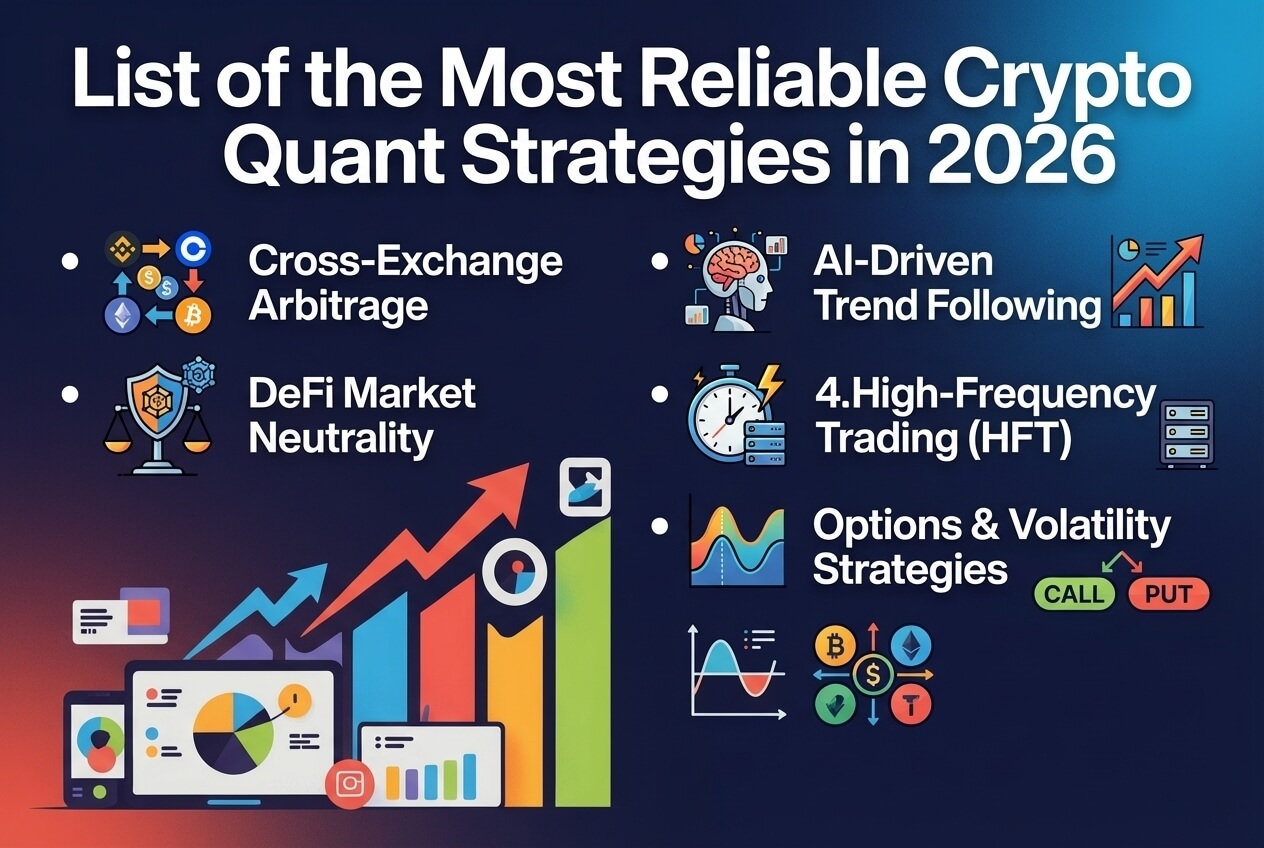
Market volatility across digital assets presents both risk and opportunity. Reliable crypto quant strategies are foundational for investors seeking stable, risk-adjusted returns as the market evolves. In 2026, the rise of AI-Powered Crypto Quant Trading and widespread adoption of automated portfolio management have established new technical and operational standards for crypto investing.
Reliability in quantitative trading extends beyond consistency. It encompasses transparent rules, measurable risk management, advanced technology, and resilience proven through both historical and live testing. Platforms combining machine learning and multi-source data, with institutional-grade risk controls and real-time monitoring, deliver accessible solutions for beginners, professionals, and institutions.
Understanding how reliability is defined, measured, and achieved is essential before selecting or implementing any quantitative strategy, especially in the dynamic crypto space. The following sections clarify key evaluation metrics, rank and describe leading strategies, and offer practical steps for safe and effective implementation.
Introduction to Reliable Crypto Quant Strategies in 2026
Quantitative strategies have matured significantly, particularly with the integration of AI technologies and advanced automation. Investors now demand strategies that are not only profitable but also resilient, transparent, and efficient.
What Makes a Crypto Quant Strategy Reliable in 2026
-
Transparent Methodology: Reliable strategies use clear, rule-based systems that are typically automated by quant trading bots and AI. Avoid opaque or "black box" methods.
-
Risk-Adjusted Returns: Success is measured by returns delivered relative to risk taken, emphasizing steady growth and avoiding excessive drawdowns.
-
Historical and Live Testing: Backtest data, live results, and continuous optimization demonstrate strategy durability across varied market environments.
-
Institutional-Grade Risk Management: Automated stop-losses, exposure management, and position sizing are essential for capital safety and longevity.
Essential Metrics for Evaluation: Sharpe Ratio, Max Drawdown, Win Rate
-
Sharpe Ratio: Indicates how much excess return is achieved per unit of risk. Higher is better, though absolute numbers vary by assets and timeframe.
-
Maximum Drawdown: Shows the largest loss from a portfolio high to low. Lower drawdown signals stronger risk protection.
-
Win Rate: The proportion of profitable trades. Useful, but reliability depends on context - high win rate with large losses on losers is less desirable.
A reliable strategy maintains consistency between historical and real-time metrics and adapts rapidly to market changes.
Top Reliable Crypto Quant Strategies for 2026
A wide spectrum of systematically proven strategies has emerged, each providing distinct approaches to risk, time commitment, and automation. Below, the ten most reliable strategies are ranked and analyzed, with key notes on performance and practical application.
1. Multi-Model Ensemble Strategies - Combining Transformers, LSTM and FinBERT Models
Description:
Integrates multiple AI models specializing in different market patterns for robust, adaptive decision-making.
Model Specialties:
-
OpenAI GPT and Transformer: pattern and event detection
-
LSTM: captures time-dependent market relationships
-
FinBERT and TimeGPT: interpret news, macro, and sentiment data
Benefits:
-
Reduces reliance on a single prediction model
-
More resilient to changing market regimes
Platform Example:
SaintQuant’s Institutional and Pro Tiers deploy these multi-model ensembles for institutional-grade execution with low, controlled drawdown.
Pros:
-
Adaptive, can be tuned for various market phases
-
Consistently outperforms solo models in backtest scenarios
Cons:
-
High computational demand
-
Parametrization complexity
2. Dollar-Cost Averaging (DCA) – Description, Benefits for Beginners, Backtest Summary
Description:
Dollar-cost averaging regularly invests a fixed amount in cryptocurrency at set intervals, regardless of market price. Timing the market is not required.
Benefits for Beginners:
-
Smooths out market entry points, reducing the impact of volatility.
-
Simple to automate with quant trading bots.
-
Encourages disciplined, emotion-free investing.
Backtest Summary:
Recent backtests (e.g., SaintQuant Starter Plan) reveal max drawdowns below 7% with positive returns, even during periods of market stress.
Pros:
-
Suitable for all levels, requires little market knowledge or time
-
Minimizes the risk of investing large sums at market peaks
Cons:
-
May underperform during prolonged bear markets
-
No active adjustment beyond scheduled buying
3. Swing Trading – Key Indicators, Risk Profile, Backtesting Results
Description:
Targets major price swings over days to weeks by entering after pullbacks and exiting near the next resistance.
Key Indicators:
-
4-hour and daily moving averages
-
RSI for momentum confirmation
-
Support and resistance analysis
-
Volume spikes
Risk Profile:
Moderate risk, as trades last several days but avoid constant exposure.
Backtesting Results:
Strategies using AI like LSTM and OpenAI GPT (as in SaintQuant Basic Plan) displayed 62–67% win rates with max drawdown under 11% for the 2023–2026 period.
Pros:
-
Effective for non-full-time traders
-
Capitalizes on predictable intermediate trends
Cons:
-
Susceptible to rapid trend reversals
-
Requires regular monitoring and discipline
4. Range Trading – Suitable Market Conditions, Technical Indicators, Real-World Examples
Description:
Buys at support and sells at resistance within a sideways (range-bound) market.
Market Suitability:
Works best in stable conditions without trending moves.
Technical Indicators:
-
RSI (using overbought/oversold levels)
-
Stochastic Oscillator for entries
-
Bollinger Bands and volume as confirmation
Real-World Example:
Backtests of major digital assets during 2025–2026 show range trading delivered 65% win rates when combined with stop-loss rules, keeping max drawdown under 10%.
Pros:
-
Produces consistent results in sideways markets
-
Can supplement trend-following approaches
Cons:
-
Vulnerable to unexpected breakouts
-
Requires frequent monitoring for shifts
5. Day Trading – Pros, Cons, Risk Management Measures
Description:
Trades opened and closed within the same day to capture short-term price movements.
Pros:
-
High frequency of opportunities
-
Fast compounding possible in volatile periods
Cons:
-
Intensive time and emotional commitment
-
Higher transaction fees and risk of slippage
-
Exposes traders to noise and overtrading risk
Risk Management:
Strict session time limits, automated stop-loss orders, and exposure monitoring are essential. Institutional-grade platforms, such as in SaintQuant’s Advanced Plan, enhance these controls with intelligent order management and dynamic risk checks.
6. Scalping – High-Frequency Approach, Indicator Uses, Fee Considerations
Description:
Involves executing many trades for small profits - sometimes hundreds per day.
Indicator Uses:
-
Real-time order book analysis
-
MACD and tick chart trends
-
Microtimeframe RSI and moving averages
Fee Considerations:
Profit margins are slim; thus, use platforms with low commissions and optimized transaction algorithms to avoid profits being eroded.
Risk Level:
Highest among common strategies; best left to professionals with suitable infrastructure.
Pros:
-
Can create steady micro-gains in liquid markets
-
Highly automatable using advanced bots
Cons:
-
High fee sensitivity and risk of system failures
-
Significant attention and technical skill required
7. Algorithmic Trading – Automation, Rule-Based Strategies, Backtesting & Optimization
Description:
Uses automated systems to run pre-defined trading rules around the clock.
Benefits:
-
Removes emotion and “human error” from decision-making
-
Backtests over long data sets for strategy refinement
-
Can handle complex, multi-asset and multi-exchange portfolios
Backtesting & Optimization:
Quant trading bots continuously update parameters, manage exposure, and minimize drawdown. SaintQuant’s automated strategies have sustained consistent Sharpe ratios across changing markets by adapting inputs over time.
Pros:
-
Scales efficiently for various crypto pairs
-
Easy integration with APIs, portfolio management tools
Cons:
-
Misconfigured rules can result in rapid losses
-
Requires active oversight and periodic updates
8. HODL / Position Trading – Long-Term Strategy, Fundamental Analysis Importance
Description:
Buys fundamentally strong cryptocurrencies to hold for months or years, capitalizing on long-term value.
Fundamentals Emphasis:
-
Project health, blockchain transparency, and institutional support are key
-
Neglects daily price moves, focusing on macro outcomes
Pros:
-
Minimal trading effort
-
Can capture multi-year market cycles
Cons:
-
Extended periods of drawdown may occur
-
Capital may remain tied up for long periods
9. Hybrid AI-Powered Strategies – Machine Learning Fusion, Trend Following & Arbitrage
Description:
Blends time-tested quant principles (like trend following) with machine learning models - such as LSTM, Transformer, FinBERT - to adaptively switch between strategies based on real-time data.
Key Elements:
-
Uses multi-source data including market prices, on-chain activity, sentiment from news/NLP
-
Adaptive rules for safer positioning during regime changes
-
Focus on minimizing drawdowns while maintaining upside
Performance:
Live and backtested results from diversified approaches (e.g., SaintQuant) reflect drawdowns under 13% with consistent gains.
Pros:
-
Highly responsive to rapid shifts
-
Automation minimizes intervention
Cons:
-
Requires trust in platform transparency
-
Complexity limits DIY implementation for non-technical traders
10. AI-Driven Real-Time Monitoring & Dynamic Exposure Adjustments
Description:
Leverages AI to monitor risk live and make instant portfolio adjustments based on volatility and shifting market factors.
Dynamic Tools:
-
Automated stop-loss triggers
-
Real-time recalculation of positions
-
Liquidity and sentiment-driven exposure controls
Pros:
-
Minimizes loss from “black swan” events
-
Increases confidence for investors with lower risk tolerance
Cons:
-
Only effective on platforms offering institutional-grade monitoring and infrastructure
Strategy Comparison Table
|
Strategy |
Timeframe |
Key Indicators |
Risk Level |
Best For |
|
Dollar-Cost Averaging |
Long-term |
Scheduled buying |
Low |
Beginners |
|
Swing Trading |
Days/Weeks |
MA, RSI, Support/Resistance |
Medium |
Intermediates |
|
Range Trading |
Days/Weeks |
RSI, Stochastic, Volumes |
Medium |
Sideways Markets |
|
Day Trading |
Intra-day |
Price action, Volume |
High |
Active Traders |
|
Scalping |
Minutes |
MACD, Order Book |
High |
Advanced Users |
|
Algorithmic Trading |
Variable |
Custom Rules/Data |
Variable |
Automation Fans |
|
HODL/Position Trading |
Months/Years |
Fundamentals/News |
Low-Medium |
Long-term Holders |
|
Hybrid AI-Powered |
Variable |
Multi-model Fusion |
Low-Medium |
Diversified Users |
|
Ensemble Strategies |
Variable |
Transformers, LSTM, FinBERT |
Low-Medium |
Institutions |
|
Real-Time Dynamic Mgmt |
Any |
AI Risk Controls |
Variable |
All Users |
Core Components of Quantitative Trading Success
Achieving success in crypto quant trading depends on disciplined risk management, rigorous backtesting, and the systematic use of technical tools.
Risk Management Essentials: Stop-Loss, Position Sizing, Exposure Monitoring
-
Automated Stop-Losses: Protect against individual trade losses
-
Position Sizing: Allocate manageable percentages per trade (usually 1–2% of capital)
-
Exposure Monitoring: Use live systems to prevent over-concentration
Backtesting and Continuous Optimization Practices: Avoiding Curve-Fitting
-
Backtest strategies across diverse market environments and years of historical data
-
Track max drawdown, Sharpe ratio, and win rate critically
-
Avoid overfitting by validating with out-of-sample periods and updating models as live data emerges
Tools and Indicators Used in Crypto Quant Strategies: RSI, Moving Averages, Stochastic Oscillator
Systematic use of technical indicators is vital. Always combine multiple indicators and confirm with real-time market data for refined accuracy.
|
Indicator |
Purpose |
Typical Timeframe |
|
Moving Averages (MA) |
Smoothing trend direction |
4H, 1D |
|
Relative Strength Index |
Overbought/oversold extremes |
15m, 1H, 4H, 1D |
|
Stochastic Oscillator |
Identifying reversals |
1H, 4H |
|
MACD |
Assessing momentum and shifts |
15m, 1H, 4H |
|
Bollinger Bands |
Volatility, reversal opportunities |
1H, 4H |
Step-by-Step Guide to Implementing Crypto Quant Strategies
Practical implementation of quant strategies requires a clear workflow and consistent oversight. Follow this stepwise checklist for optimal results.
Setup Checklist: Selecting Indicators, Defining Entry/Exit Rules, Demo Backtesting
-
Choose target crypto assets and reliable exchanges.
-
Select primary indicators (e.g., RSI, MACD, MA, order flow).
-
Define strict entry and exit rules (for example: MA crossover triggers entry, RSI above 70 triggers exit).
-
Backtest on several years of historical data, across both bull and bear markets.
-
Paper trade (demo trade) for 1–3 months and record every simulated trade.
-
Set risk limits: install stop-loss, limit position size, establish a max daily loss.
-
Review trade logs and refine parameters as needed.
Managing Risks: Setting Stop-Losses, Monitoring Drawdowns, Dynamic Adjustments
-
Use automated stop-loss per trade
-
Monitor aggregate drawdown and pause trading if thresholds are hit
-
Adjust position sizing dynamically, based on volatility
-
Prefer platforms providing real-time monitoring and rapid response tools
Common Pitfalls: Overfitting, Ignoring Market Conditions, Neglecting Fees and Slippage
-
Overfitting: Avoid excessive tweaks to fit historical data at the expense of forward performance
-
Market Blindness: Do not use trend systems in sideways markets - or vice versa
-
Missing Cost Analysis: Always account for trading fees and slippage in test results
-
Rule Deviations: Maintain discipline; emotional or ad hoc changes increase risk
For active management and portfolio oversight on the go, download the SaintQuant mobile trading app for real-time strategy tracking and adjustments.
Disclaimer:
The information provided is for informational purposes only and does not constitute financial, investment, legal, or tax advice. All investments involve risk, including the possible loss of principal. Past results do not guarantee future returns. Please conduct your own research or consult with a qualified advisor before making financial decisions.
Emerging Trends & Developments in Crypto Quant Trading for 2026
Crypto quant trading in 2026 is defined by the fusion of pioneering AI models, advanced automation, and regulatory compliance.
Advances in AI and Machine Learning Models in Quant Trading: GPT, Transformer, FinBERT, TimeGPT
Modern quantitative trading integrates a suite of AI models:
-
OpenAI GPT and Transformer: Detect non-linear patterns, generate dynamic signals from diverse inputs.
-
LSTM: Handles time-series data for sequence prediction.
-
FinBERT and TimeGPT: Processes financial news, sentiment, and macro trends for smarter signals.
Ensemble model usage is rising, reducing overfitting and bolstering adaptation to new regimes. Institutional-grade systems deliver lower max drawdown and robust performance by combining these models.
Regulatory Impacts on Algorithmic and Automated Trading Strategies
Increasing oversight, including stricter KYC policies and leverage restrictions, shapes quant bot structure and compliance. Platforms now emphasize transparency, audit-ready logs, and robust risk controls to meet global standards.
Multi-Source Data and Real-Time Monitoring for Enhanced Decision-Making
Best-in-class platforms synthesize technical, order book, on-chain, and fundamental data for comprehensive, context-aware trades. Real-time monitoring, enabled by AI, ensures portfolios adapt while minimizing losses during fast-moving events and anomalies.
For details about SaintQuant's contribution to these trends, learn about SaintQuant’s mission and technology.
Conclusion and Next Steps
Reliable crypto quant strategies in 2026 are built on transparency, robust risk management, and adaptive automation. By combining advanced AI, continuous live monitoring, and proven approaches (such as DCA, swing trading, and hybrid ensembles), investors of all profiles can pursue stable, risk-adjusted returns.
Identify strategies that fit your risk appetite and objectives. Explore the full range of flexible pricing plans and AI quantitative trading strategies at SaintQuant to match your investing style - whether beginner, experienced, or institutional.
Seize the opportunity to start with a low-risk package or a free trial to evaluate performance and platform reliability. If prepared to begin, simply create your SaintQuant account for access to automated quant trading and institutional-grade controls.
Caution:
Crypto investments are inherently risky. Past performance cannot guarantee future outcomes. Conduct independent research and seek professional guidance before making investment decisions.
Frequently Asked Questions about Crypto Quant Strategies in 2026
What is the Most Reliable Crypto Quant Strategy for Beginners?
Dollar-Cost Averaging (DCA) remains the safest and most reliable - fixed interval purchases result in smoother price entry and reduce the need for market timing. Automation options make implementation simple.
How Does Algorithmic Trading Differ from Manual Methods Like Swing Trading?
Algorithmic trading utilizes automated rules to identify and execute trades, reducing emotional error and saving time. Manual swing trading relies on discretionary decision-making and requires ongoing attention.
Which Technical Indicators Are Most Effective for Range and Volatile Markets?
In range-bound markets, use RSI, Stochastic Oscillator, and Bollinger Bands to pinpoint support/resistance reversals. In highly volatile markets, moving averages and MACD help separate meaningful trends from noise.
What Are the Key Risk Management Practices All Traders Should Follow?
-
Always set stop-loss and take-profit levels.
-
Keep a consistent position size, typically 1–2% of your capital.
-
Monitor total drawdown and pause trading if losses exceed set thresholds.
-
Use live monitoring and automation to manage risk in real time.
How Can Backtesting Be Conducted Safely Without Real Money?
Use demo accounts and dedicated backtesting modules on reputable platforms. Simulate trades, log outcomes, and avoid risking funds until results show satisfactory consistency.
Is Dollar-Cost Averaging Still Effective Amid Increased Market Volatility?
Yes, DCA is resilient to volatility, as it enforces disciplined investing regardless of short-term swings and avoids lump-sum risks.
Comparing Scalping and HODL: Pros and Cons for Different Investors
Scalping can generate many small wins but requires advanced skill, speed, and fee management. HODL is simpler, needs patience, and is best for those preferring a less active approach, but can lead to lengthy drawdowns if entered at a market top.
How Have AI Advancements Influenced Crypto Quant Strategies in 2026?
AI enables faster recognition of evolving market conditions, more accurate sentiment tracking, and automated shifts in strategy. Models like Transformer, LSTM, and FinBERT together reduce drawdowns and improve adaptability.
Common Mistakes in Crypto Day Trading and How to Avoid Them
Frequent pitfalls include overtrading, underestimating fees, and overreacting emotionally. Adhere to rules, limit trade quantity, and log all activity to review and learn.
Optimal Timeframes for RSI and Stochastic Signals in Crypto Trading
Use 15-minute RSI for scalping, hourly RSI for day trading, and 4-hour/daily for swing strategies. The Stochastic Oscillator is generally most reliable on 1-hour and 4-hour charts.
For more detailed answers and in-depth clarifications, see the Frequently Asked Questions about AI Crypto Trading.